Judgment and elimination of faults that cause abnormal noises
The judgment and elimination of the fault that causes the abnormal noise need to be based on the size of the noise and the place where it is emitted.Whether the degree of vibration is continuous or intermittent, whether the noise increases when the working temperature of the diesel engine is high, or when the working temperature of the diesel engine is low, and whether the noise can be heard clearly when the diesel engine is under load, is the sound gradually increasing or suddenly appearing, etc. characteristics and changing laws. Combined with the newness of the machine, the use and maintenance conditions, comprehensive consideration, comprehensive analysis, continuous practice, and gradual accumulation of experience, in order to analyze and judge the factors that cause the failure according to different sounds.
Therefore, the auscultation of sound requires not only a certain theoretical knowledge, but also a wealth of practical experience in order to judge accurately, so as to avoid the rapid damage of parts and even accidental damage due to untimely troubleshooting.
For the faults that do not need to be eliminated immediately, if they are eliminated immediately, it will cause undue waste and time for downtime for repairs or may delay the operation of the ship, and the noise may not necessarily be eliminated.
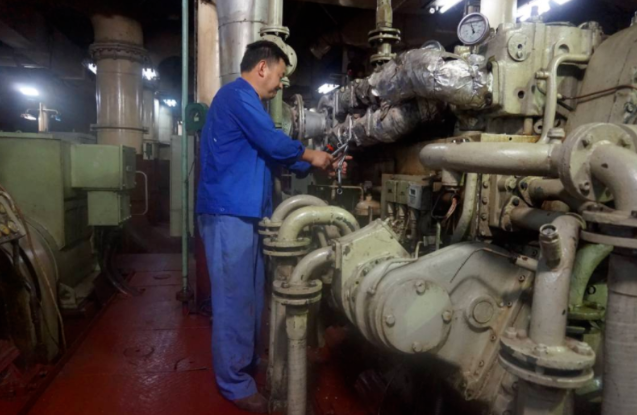 Several common noise phenomena and causes are as follows:
1. Percussion sound of main bearing
Phenomenon: This is a thick and dull knocking sound. The faster the engine rotates, the louder the sound. When the accelerator is suddenly increased, there is a heavy "clang, clang" sound, and the sound increases with the increase of the engine load.
Reason:
1) The bearing cap fixing bolts are loose;
2) The lubricating oil supply in the bearing is insufficient or too thin, and the friction is overheated, causing the bearing bush alloy to burn or fall off;
3) The bearing bush and journal are severely worn, and the radial gap is too large, resulting in loosening;
4) The axial clearance of the crankshaft is too large.
2. The sound of the main shaft bush
Phenomenon: The tone is a low muffled and heavy "hum.hum" sound. When the temperature of the diesel engine is low, the sound is small, and when the temperature is high, the sound is loud. When running at full load, the sound is the loudest. When the speed is increased suddenly or the load is suddenly increased, the sound is the clearest.
In the single-cylinder oil-cut test, there is no obvious change in the sound. When the sound is serious, the body vibrates and sways. The accompanying symptoms are that the pressure of the lubricating oil is significantly reduced, and the sound produced by the bending or cracking of the crankshaft is similar to the sound of the main shaft bushing, but the tone is messy, turbid, and No rhythm.
Reason: The crankshaft main journal and the bearing bush are worn or the bearing bush alloy is peeled off and ablated, causing the gap between the main journal and the bearing bush to be too large. When the diesel engine is working, the main journal and the main bush collide with each other and produce noise.
3. The percussion sound of connecting rod bearing
Phenomenon: The percussion sound of the connecting rod bearing is a "clang, clang" sound that is lighter, gentler and shorter than that of the main bearing;
During the sudden acceleration, there is a continuous obvious knocking sound.
Reason:
1) The fixing bolts of the connecting rod bearing caps are loose or broken;
2) The bearing bush alloy is burnt or falling off;
3) The bearing and journal are severely worn, and the radial clearance is too large.
4. The sound of connecting rod bearing bush
Phenomenon: The tone is short, dull and heavy, solid and rhythmic "ta, ta" sound, the multi-cylinder diesel engine also often makes a "clack-clack-clack" sound.
The sound of the diesel engine is obvious when the speed is increased and the load is increased, and the sound is the clearest when it is suddenly accelerated or the load is suddenly increased;
When the working temperature of the diesel engine is low, or after replacing the thick lubricating oil, the sound becomes weaker, and the accompanying feature is that the lubricating oil pressure decreases.
Reason: The clearance between the connecting rod journal and the connecting rod bearing bush is too large, and when the piston changes directions at the top and bottom dead centers, the connecting rod journal and the connecting rod bearing bush collide with each other and produce noise.
5. Piston knocking sound
Phenomenon: Rhythmic, dull "click, click" metal percussion sound; when the piston is located near the top dead center of the cylinder, the sound is louder and clearer than when the piston is located near the bottom dead center;
When the temperature of the diesel engine is low, the sound is loud, and when the temperature is high, the sound weakens or disappears;
When the diesel engine is at low speed, or when the speed is suddenly increased or dropped suddenly, the sound is obvious.
Reason: The interstitial gland between the piston and the cylinder wall is too large, which causes the piston to sway when it reciprocates in the cylinder. When the direction of the upper and lower dead centers of the piston changes, it collides with the cylinder wall and produces a sound. At the moment when the power stroke starts, the sound is heard maximum.
6. Piston against cylinder sound
Phenomenon: In the vicinity of the movement of the piston of the cylinder block, a metal knocking sound similar to the lively cold knocking sound can be heard. The tone is dull and the frequency is high. When the temperature of the diesel engine is low, the sound is small and loud when the temperature is high. When the speed is increased, the sound is the loudest.
Reasons: The clearance between the piston pin and the piston pin hole, or the connecting rod bushing is too small, the clearance between the connecting rod journal and the connecting rod bearing bush is too small, the center line of the cylinder is not perpendicular to the center line of the crankshaft, the crankshaft main journal and the connecting rod journal The centerlines are not parallel.
The common consequence of these is that the connecting rod cannot swing freely or is difficult to swing freely, so that the piston hits the cylinder wall at the top and bottom dead centers and makes noise.
7. Piston pin sound
Phenomenon: The tone is high, sharp and crisp, much like the "click, click" sound of hitting an anvil with a small hand hammer. The loudest sound is in the upper part of the cylinder block. After the temperature of the diesel engine rises, the sound generally does not weaken, and sometimes it is more obvious. When the speed is low or the speed is suddenly increased, the noise is the most obvious and serious. The higher the speed, the louder the noise.
Reason: The clearance between the piston pin and the connecting rod bushing or with the piston pin hole is too large. At the moment when the compression stroke is converted into the power stroke, the piston pin hits the connecting rod bushing or the piston pin hole and makes a noise.
When it is serious, in other strokes, the piston also makes a noise when the direction is changed at the top and bottom dead centers.
8. Valve sound
Phenomenon: The tone is a crisp and sharp "pop" sound. When the diesel engine runs at low speed, the sound is clearer.
Reason: improper adjustment of valve clearance, loose valve clearance adjustment screw, bending deformation of push rod, loosening of rocker arm shaft seat fixing screw, wear of transmission rod, resulting in excessive valve clearance, and the end face of the valve rod hits the rocker arm during operation and makes noise.
 Sinooutput—— Your shipbuilding one stop spare parts supplier and consultant.
Sinooutput had serviced more than 398 shipyard oversea, the ship types includes cargo ship, container ship, bulk carrier, fishing boat, oil tanker, LCT, Ro-ro and sand suction ships, tug boat, ice-breaker, militray boats and all kinds of speed yachts.
If you have any questions and inquiries about our products, please add WhatsApp 008613564780885, or leave us a message. We will provide you with professional consulation and catalogs.